Sonic Injection in Los Angeles County

Updated: Mar 27
The Legacy team recently completed a project in Los Angeles County that began as a Zero‑Valent Iron (ZVI) sonic injection and later transitioned to EVO injection within 4" PVC Cement Cased Wells.

Prior to Legacy’s involvement, the project experienced multiple mobilizations with different contractors:
Mobilization #1
Installed cement‑cased wells
Perforated some of the cased wells
Attempted ZVI slurry injection into the perforated cased wells
Mobilization #2
Advanced direct‑push injection tooling
Utilized a combination of auger drilling, CPT, and Geoprobe methods
Attempted ZVI slurry injection
Mobilization #3
Advanced direct‑push injection tooling
Utilized auger drilling and Geoprobe methods
Attempted ZVI slurry injection
After limited success with these three mobilizations, Legacy was brought in to perform Zero‑Valent Iron (ZVI) Injection using Sonic Drilling method.


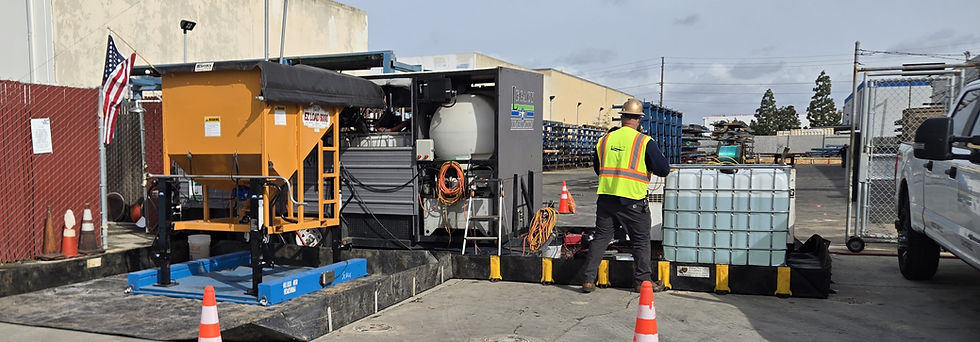
The 74–425 micron F‑1 Zero‑Valent Iron (ZVI) was supplied by CERES in 2,205 pound super sacks and was already onsite. Legacy managed all bulk handling and measurement of the ZVI using our bulk loader equipped with load cells.

CERES also supplied cellulose fiber and Newman Zone® QR‑75, which were incorporated into the injection mixture.

A small amount of guar gum was also used to help keep the ZVI suspended in the mixture.

The ZVI, cellulose fiber, Newman Zone® QR‑75, and water slurry were prepared in our dual 400‑gallon mixing tanks.

Unfortunately, due to the very challenging fine‑sand geology this area is known for, we experienced limited success with Direct Sonic Injection (DSI).

Packer Sonic Injection (PSI) was also attempted, with similarly limited results.

In some cases, we achieved great ZVI slurry injection flow (15–20 gpm) with relatively low injection pressures (<150 psi).

In other cases, we were unable to even achieve flow during the water injection test at pressures up to 1,500 psi. When the tooling was removed, however, everything was clear and showed no signs of plugging.
After trying several alternative approaches with limited success, our client elected to discontinue ZVI injection and asked Legacy to evaluate injection into 31 cement‑cased wells that had been installed by the first injection contractor. These cement‑cased wells consist of 4‑inch Schedule 40 blank PVC installed via sonic drilling to depths of up to 110 feet, within 8‑inch diameter borings, and sealed in place with a cement grout.

We did some testing at our shop using a 10,000 psi Injection pump and developed a reliable and repeatable procedure to perforate the 4‑inch PVC casing and surrounding cement grout. Through this testing, we demonstrated the ability to create two perforations through the 4‑inch PVC and 8‑inch diameter cement grout in approximately 90 seconds.

Once in the field, after perforations were completed across the 20‑foot treatment interval, we conducted an injection test and achieved 30+ gpm flowrate under gravity feed (0 psi).
Based on these results, we transitioned to EVO injection within the cement‑cased wells.

Tersus provided the reagents for this phase of the project, including EDS‑ER Electron Donor Solution, an extended‑release, vegetable oil‑based substrate concentrate, which was delivered to the site in 2,100‑gallon totes.

Tersus also supplied EDS‑Substrate Shuttle and EDS‑Activator, which were delivered in 55‑gallon drums.
Both of these products are flammable liquids, and because only small quantities were required per batch, we used intrinsically safe, hand‑operated drum pumps for our batch mixing.

As perforation of the cement casings progressed, we initiated EVO injection, connecting to multiple Wells.

Some of the wells were located within a critical driveway, so we utilized crossover ramps along with low‑profile wellhead adapters at these locations.

Because the hydrant orientation would have directed our hose into traffic, we utilized a 90‑degree fitting with flexible hose to avoid street interference and installed a crossover ramp to maintain safe pedestrian access.
e

At our second staging area, we had to run 50 feet of hydrant crossover ramps across the criticl driveway.
Because we were working directly in front of a large, high‑profile business, we installed privacy fencing around our mixing and pumping equipment to maintain a clean, orderly appearance and minimize disruption. This approach created a clear exclusion zone while keeping the work discreet, an effort that the client and the tenant greatly appreciated.

This was a very challenging project for our client, compounded by difficult subsurface geology. Given the conditions, it was no surprise that prior contractors also encountered significant obstacles. We’re glad we were able to work through these challenges and ultimately find a successful path to inject amendments for groundwater treatment.
We’re extremely proud of our team’s hard work and determination on this project. Their mindset of “failure is not an option” was a key factor in overcoming the challenges and getting the project across the finish line.